
The AI coding agent that fits in 10 MB.
Gritcode is a native desktop agent harness for DeepSeek V4, written in C++ instead of wrapped in Electron. It plans, writes, runs and fixes your code, then launches your app with one click. The free tier needs no sign-up.
Everything an agent needs. Nothing you don't.
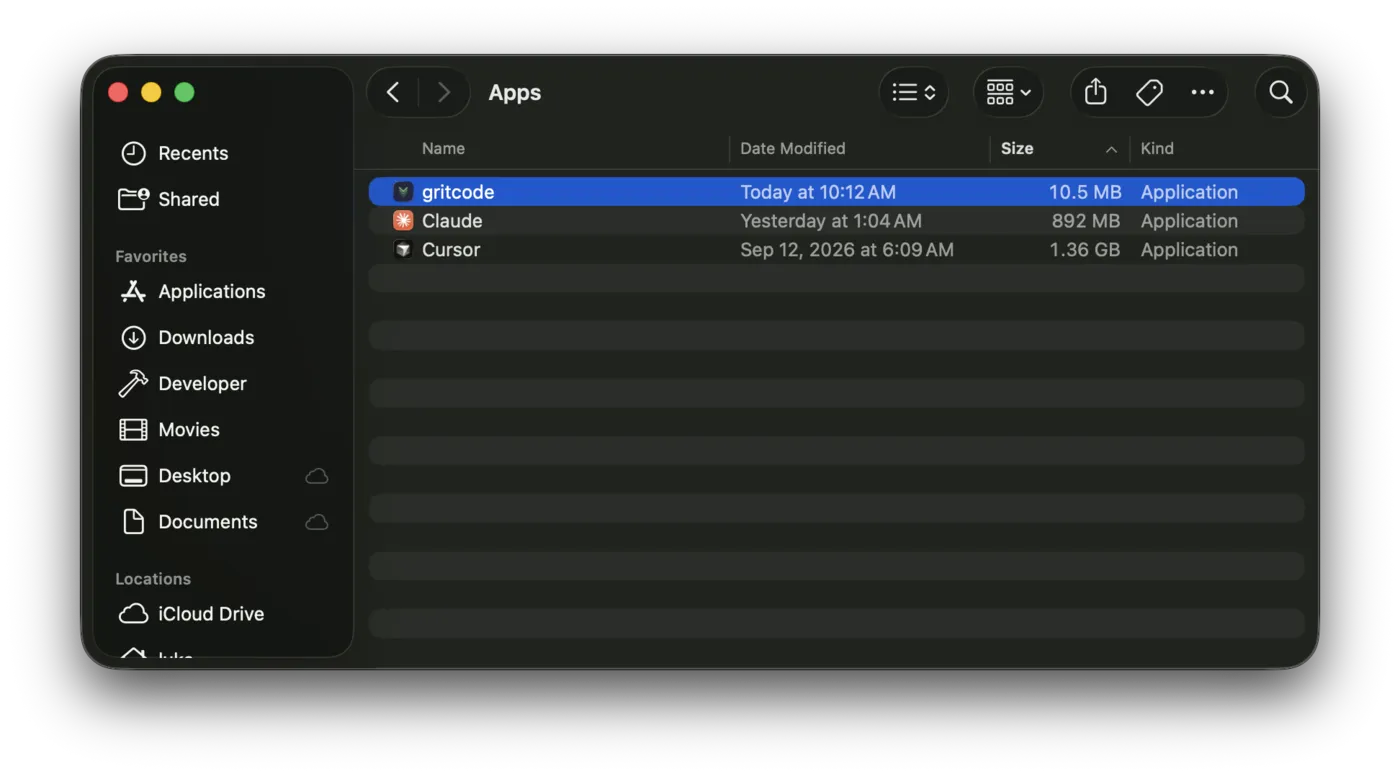
Claude's desktop app takes up 892 MB. Cursor takes 1.36 GB. Gritcode is 10.5 MB: one C++20 binary built on wxWidgets. It opens instantly, uses no CPU while you think, and stays under 60 MB of RAM. Cursor idles at about 1.6 GB, and the Claude app at about 1.8 GB.
Built for how you actually code with agents.
Chat, tools, editor and runner in one small window. Every clip below is a real, unedited recording.
Prompt it, then press ▶ Play.
Ask the agent to build something. It installs dependencies, checks that the app launches and saves the run command. After that, the Play button builds and runs your project directly, with no AI round-trip and no tokens spent.
- Works with any stack: Python, C++, Node, Rust, or anything your shell can run
- Output and tracebacks come back into the chat, ready for the next fix
- Run configuration is saved per project
The IDE, cut down to what still matters.
When an agent writes the code, you type less and review more. You still need to see the code and the project outline and make small changes, so Gritcode keeps a file tree and an editor with tree-sitter syntax highlighting, right beside the chat. The rest of the old IDE's clutter is gone.
- Tree-sitter highlighting and smart indentation
- New file, new folder, rename, reveal in Finder or Files
- Unsaved-changes protection and a draggable split
Sessions you can share and replay.
Export any conversation, images included, to a single .gritsession file. Load it as a reference next to a fresh session and click any prompt to reuse it. You can rebuild a project from a playbook on a new machine, in a new folder, with a newer model.
- One-file export with attachments
- Reference pane shown side by side with your live session
- Click a prompt to copy it into the current session
A complete agent harness, not a chat window.
Memory across projects
Every session is indexed with SQLite full-text search. The agent can look up how you solved something in another project and pull that context in.
Cheap long sessions
Context is compacted only near the model's limit. A token-budgeted tail stays verbatim and summaries carry forward. The result: long sessions without runaway API bills.
Real tools
Bash, read, write and edit files, list, grep, web search and URL fetch. Collapsible tool cards show exactly what ran and what came back.
It can see your screenshots
Drag images into the message box. They're sent to a DeepSeek vision model, so the agent can see the UI bug you mean.
Native on every desktop
The new Tahoe look on macOS and GTK on Linux. SF Mono code, overlay scrollbars, and it follows your dark or light theme.
Keys in your keyring
Your API key is stored in the macOS Keychain or the Linux Secret Service, never in a plain-text dotfile.
Streaming markdown
Headings, tables, code blocks and thinking blocks render live as the model types, on a custom native canvas.
Your real environment
Commands run with your login shell's PATH, so your toolchains, virtualenvs and version managers work the same as in your terminal.
Open source, GPLv3
Read the code, build it yourself, send a pull request. There's no paid tier and no lock-in.
Frontier-class coding at DeepSeek prices.
Gritcode connects straight to DeepSeek, so there's no middleman, markup or subscription. You can also start on the free tier with no API key at all.
Kilo Free
Runs anonymously on the free Kilo tier. It's the default when no key is set, so you can open the app and start right away.
DeepSeek V4.1 Flash
The latest DeepSeek V4 Flash: fast and very inexpensive. Good for everyday edits, scaffolding and quick questions.
DeepSeek V4 Pro
DeepSeek's strongest model for hard refactors and long agentic runs, with a context window of roughly a million tokens.
The model list is fetched live from DeepSeek, so new models show up without an app update. Gritcode as a DeepSeek desktop app →
The model is the brain. The harness is everything else.
On its own, a language model only predicts text. A coding agent harness wraps it in a loop. It gives the model tools such as the shell, your files and the web, feeds the results back, manages the context window, remembers past work and shows you what's happening.
The harness largely decides how useful an agent is, and how much it costs to run. Most harnesses today live in a terminal or ship inside a browser engine. Gritcode is a harness with a proper native GUI, and it's lean enough to leave open all day.
What exactly is an agent harness? →
How Gritcode compares to Claude Code, Cursor and DeepSeek Harness →
Free forever. Funded by the people who use it.
Gritcode is built by one developer, Luke, with help from AI agents. There's no VC money, no paid tier and no ads. Sponsors keep new releases coming.
- Signed macOS builds. Apple Developer membership, so the app opens without warnings.
- API credits for testing. Every release is tried against real models on real projects.
- Time. New features, faster fixes, and macOS and Linux kept in step.
Sponsor the project
Monthly or one-time, through GitHub Sponsors. It goes straight into Gritcode releases, signing and fixes.
Sponsor on GitHubSupport Luke directly
Back the author on Patreon. It funds Gritcode and the DevMindscape programming tutorials on YouTube.
Join on PatreonCan't sponsor right now? Star the repo, tell a friend, or report a bug. It all helps.
Get Gritcode
It's a 3.5 MB download. You'll be coding before an Electron app finishes updating.
Downloads come straight from GitHub Releases, where you'll also find the changelog and older versions.
Build from source
Linux
sudo apt install build-essential cmake ninja-build pkg-config \
    libwxgtk3.2-dev libgtk-3-dev libcurl4-openssl-dev \
    libsqlite3-dev libsecret-1-dev
git clone https://github.com/lszl84/gritcode.git && cd gritcode
cmake --preset release
cmake --build --preset release
./build/gritcode
macOS
brew install cmake ninja
git clone https://github.com/lszl84/gritcode.git && cd gritcode
cmake --preset release
cmake --build --preset release
open ./build/gritcode.appQuestions, answered.
Is Gritcode free?
Yes. Gritcode is free and open source under GPLv3. The default Kilo Free model works without an API key or sign-up. If you use DeepSeek V4, you pay DeepSeek directly for the tokens you use, and Gritcode adds no markup.
What is an AI agent harness?
It's the software around a language model that turns it into an agent: the loop that calls the model, the tools it can use (shell, files, search), context-window management, memory and the interface. Gritcode is a coding agent harness built for DeepSeek V4.
Which models does Gritcode support?
DeepSeek V4 Pro and V4.1 Flash with your own DeepSeek API key, plus a free Kilo model that needs no key. The DeepSeek list is fetched live, so new models appear automatically.
Is Gritcode an alternative to Claude Code or Cursor?
Yes, if you want an agentic coding assistant that's native, open source and inexpensive to run. Gritcode is about 10 MB on disk, compared with 892 MB for the Claude desktop app and 1.36 GB for Cursor, and it runs DeepSeek models instead of a subscription. Full comparison.
Can I use DeepSeek with Claude Code instead?
Yes. DeepSeek offers an Anthropic-compatible API that Claude Code can use through environment variables. See our Claude Code + DeepSeek guide. Gritcode is the no-setup option: paste your DeepSeek key in Settings and start.
Which platforms does Gritcode run on?
macOS 14 Sonoma or later on Apple Silicon (signed .dmg), and Linux: Ubuntu and Debian (.deb). You can build it from source with CMake on either. More about Gritcode on Linux.
Where is my code sent?
Only to the model provider you pick (DeepSeek or Kilo), as part of the conversation. Sessions and memory are stored locally in SQLite on your machine, and API keys live in your OS keyring.
How can I support Gritcode?
Sponsor the project on GitHub Sponsors or support the author directly on Patreon. Starring the repo and sharing Gritcode helps too.